
What to See in Brindisi: The Complete Guide to the Places Not to Miss
From the Monumento al Marinaio to the Roman Column, discover Brindisi's must-see sights in 1, 2 or 3 days.
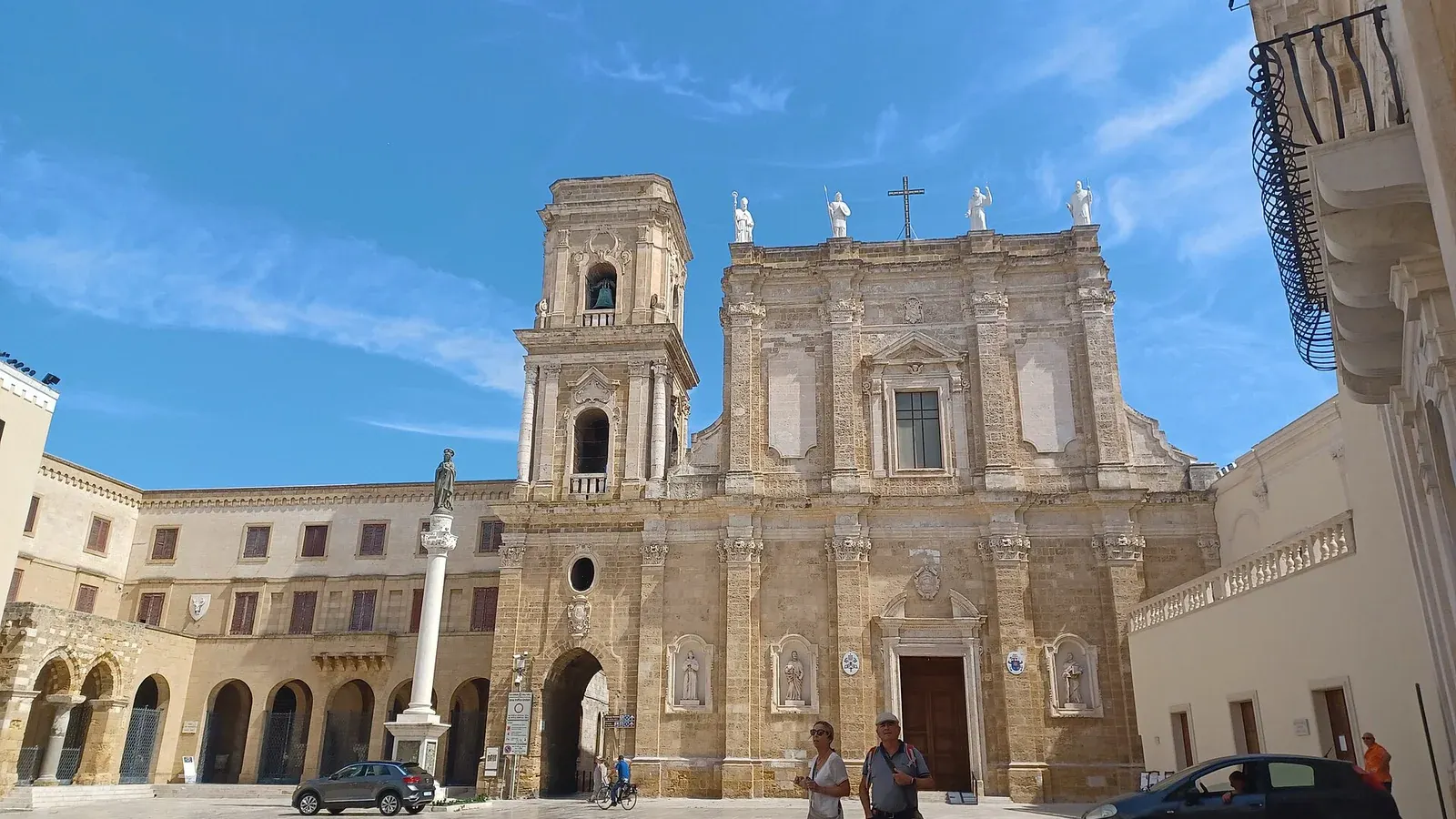
In short: In one day you can see the centre of Brindisi on foot: Piazza Duomo and the Cathedral, the Roman Columns where the Appian Way ended, the Regina Margherita seafront and, by water bus, the Sailor Monument. With two or three days, add the Archaeological Museum, Santa Maria del Casale, Cillarese Park and the murals of the Paradiso district.
What to See in Brindisi in One Day
If you only have one day, focus on the old town: this is where you'll find the city's most iconic monuments and its most beautiful squares. You can also take a short trip on the motobarca and stop on the other side of the harbour, in the Casale quarter.
Morning: the heart of the old city
Piazza del Duomo is the ideal starting point. Brindisi Cathedral, built in the twelfth century and reworked in Baroque style, dominates the square together with the Bishop's Palace and the Portico of the Knights Templar. It's worth going in to admire the medieval baptismal font and the mosaic floors. Also in Piazza Duomo you can admire the "Loggia Balsamo", a historic monument that forms the balcony of a fourteenth-century palazzo.
A few steps away you'll find the Roman Columns: the symbol of Brindisi. One of the two original columns still stands with its capital (the one on top is a replica, but you can see the original in Palazzo Granafei Nervegna); the other fell in 1528, and some of its pieces were used to build a column in Lecce. These columns marked the end of the Via Appia, the most important consular road of the Roman Empire, today a UNESCO World Heritage Site.
The Castello Alfonsino (or Sea Castle) stands on the islet of Sant'Andrea, reached by a narrow stretch of man-made road. Built by the Aragonese in the fifteenth century, today it can be visited in all its splendour. It's worth going out there just for the view of the harbour.
Afternoon: the harbour and the seafront
The Lungomare Regina Margherita is one of the most beautiful seafronts in southern Italy. Stroll past the Art Nouveau buildings and enjoy the view of the harbour as the ferries to Greece come and go and the motobarca shuttles between the two sides. The seafront comes alive above all at sunset, when the people of Brindisi take their traditional evening stroll.
The Monumento al Marinaio d'Italia is a memorial to the Italian sailors who died in the First World War. Shaped like a rudder and 53 metres tall, it stands on a small hill above the harbour. Inaugurated in 1933, it can be seen from far away and offers a panoramic view over the city and the sea. The few minutes' walk up to its base are well worth it.
The Swabian Castle (Norman-Swabian Castle), built at the behest of Frederick II in 1227, looks directly onto the inner harbour. Today it is used by the Navy. Its strategic position offers one of the best views of the port of Brindisi.
Evening: aperitivo and dinner in the centre
End the day with an aperitivo in Piazza Vittoria or on Corso Umberto I, the city's drawing room. The bars in the centre serve excellent cocktails with snacks made from local produce. For dinner, choose one of the little restaurants in the old town and order ciceri e tria or orecchiette with turnip tops.
What to See in Brindisi in 2 or 3 Days
With two or three days you have time to go deeper and discover some less touristy corners too.
Day two
Start at the Francesco Ribezzo Provincial Archaeological Museum, housed in an elegant historic palazzo in Piazza Duomo. It brings together Messapian, Greek and Roman finds from all over the Brindisi area: bronzes, terracottas, jewellery. Among them, the Brindisi bronzes are the most important pieces.
The Church of Santa Maria del Casale (12th-14th century), just 4 km from the centre, is considered one of the masterpieces of Apulian Romanesque-Gothic architecture. The fourteenth-century frescoes covering the interior walls are remarkably well preserved. It's easy to reach on foot or by bike.
In the afternoon, a walk in the largest urban park in Apulia, the Parco del Cillarese, is a small natural oasis inside the city, with a wetland habitat and remarkable biodiversity. Renting a bike to ride all the way round it is a good idea too.
Day three
For the third day, the idea is to step off the tourist trail and discover a different Brindisi, made of working-class neighbourhoods, street art and little-known views.
Start the morning in the Paradiso quarter, a residential area that in recent years has turned into a real open-air gallery. Here you can admire a number of street-art murals by local and international artists, telling stories about the identity of the neighbourhood, the sea and Mediterranean culture. Walking among these colourful buildings is a different, more contemporary way to get to know the city.
Carry on to the Sant'Elia quarter, another working-class area that has been part of urban regeneration projects in recent years. Here too there's public art and green space, and it's an interesting place to see the everyday life of the people of Brindisi away from the old town. On Thursdays there's a big market here, drawing curious visitors and traders from all over the province.
For lunch, you can stop at a neighbourhood trattoria: these are often the best places to taste authentic, simple cooking that isn't aimed at tourists.
In the afternoon head back to the sea, but from a different angle than on the previous days. The Casale side of Brindisi's inner harbour offers very evocative, quieter views, ideal for a peaceful walk. From here you can look at the city "from across the water", with an unusual view of the old town.
If you'd like to add a light cultural stop, you can visit Palazzo Granafei Nervegna, where the original capital of the Roman column is kept: a detail that often escapes those who only pass through the city.
End the day by heading back to the centre for a last evening stroll, perhaps revisiting the places you liked most. Having seen the outlying areas too, you'll have a complete picture of Brindisi: not just a port city of monuments, but a lively, contemporary place in transformation.
List of places to see
| Place | Type | Distance from the centre | Admission |
|---|---|---|---|
| Roman Columns | Monument | Centre | Free |
| Piazza del Duomo | Historic square | Centre | Free |
| Swabian Castle | Fortress | Centre | Free, open only on some weekends |
| Castello Alfonsino | Fortress | Harbour | €7.00 |
| Monumento al Marinaio | Monument | Harbour | €3.00 |
| Lungomare R. Margherita | Promenade | Harbour | Free |
| Archaeological Museum | Museum | Centre | €1.00 |
| Church of S. Maria del Casale | Church | 4 km | Free |
Getting Around Brindisi
Brindisi's old town is very compact and on the whole easy to explore on foot. It takes about 10-15 minutes to walk from the railway station to the harbour. The main car parks are on Via Spalato.
To get around the city, especially to outlying areas such as Casale or Paradiso, you can easily use the city buses, which connect the different parts of Brindisi fairly thoroughly.
For the surrounding area (Ostuni, Mesagne, the beaches), a car is the most convenient option. Otherwise there are provincial buses, and if you're staying at Giardino del Geco B&B you can ask us for advice on the best options, and we have a partner car rental!
This article is taken from www.giardinodelgeco.it.